Are we in base reality?

Every year, late July, I meet with my geek friends at euskal.org, a computer enthusiasts party where we share our love for computers, undersleep and follow a strict diet of pizza and energy drinks.

Last year I was able to play with an HTC Vive Virtual Reality headset, and I’ve been wanting to get one ever since. The VR experience was amazingly immersive.

I played “starwars, trials on Tatoonie” and by putting my headset on I was no longer in Spain, I was in the desert of Tatoonie, I could look around me and see everything as I would expect to see in normal reality. By putting the headphones on, the immersion was complete. Not only could I see things, but I also could hear R2D2 and Han Solo speaking to me, the Millennium Falcon engines roar and the hum of my lightsaber.

Elon Musk thinks there is a “one in Billions” chance our reality is not a simulation. At the rate of advance of technology, simulations and videogames are becoming every time more realistic, from pong being two lines and a dot 40 years ago to the photorealistic games we have today.  We are clearly in a trajectory to build games that are indistinguishable from reality. Maybe it could take us 10.000 years to get there, but on a cosmic timescale this is not much time. If we accept we will at some point be able to create a simulated reality, with individuals existing within its confines, then, since mathematics will be the same, at some point the inhabitants of this sub-reality will themselves be able to create a sub-sub-reality, and so on indefinitely. Once you accept this argument has no flaw, the next logical question is: are we in a simulation? are we in base reality?

A hypervisor is a piece of software that sits between the hardware and the operating system of a computer, providing it a simulated hardware. The operating system does not know it is running within the confines of a virtual machine.

In 2006, Joanna Rutkowska presented at the Black Hat Briefings an attack named “blue pill rootkit” against the Windows Vista kernel protection mechanism. This attack moved Windows to a virtual machine, so the operating system seemed to run normally, but in reality the machine was owned by the hacker, who could run other software on the hardware outside of the virtual machine.

Rutkowska also developed “red pill”, which would allow an operating system to know whether it was running within the confines of a simulation or on real hardware.

If one of the simulated realities was able to detect whether or not it was living within a simulation, similar to “red pill”, it could communicate with the outer environment, even hack into it running arbitrary code. God could be hacked.


redpill

Surviving Artificial Intelligence

“The ever accelerating progress of technology … gives the appearance of approaching some essential singularity in the history of the race beyond which human affairs, as we know them, could not continue.” – John Von Neumann


In 1997, Deep Blue beat Garry Kasparov at chess by calculating using brute force the possible next moves and choosing the best one. No human will ever be able to beat A.I. at chess.

In March 2016, Google’s AlphaGo software beat Lee Sedol at Go, using a new method called “deep learning”.  This new technique enabled a computer to learn on its own, playing against itself to improve its game.

One of the few games humans are still undefeated by machines at is crosswords, because machines still find it difficult to infer that a three letter whiskered animal that hunts mice and loves milk is a cat. However even here AI promises to beat us in the near future. Currently Google Translate’s AI is capable, after being taught to translate from English to Japanese, and from English to Korean, to translate directly from Japanese to Korean, without using English. This means the AI has created its own language!

Moore’s Law observes that computing capacity doubles every year. Seeing where we are today and projecting this accelerating rate of advance into the future, it is probable that at some point we will be able to create an AI which is as smart as a squirrel. Some time after that as smart as a chimpanzee. At some point AI will reach human intelligence, but there is no constraint stopping it there. Once AI is capable of enhancing itself past the level of human intelligence, very fast we humans will be closer to the intelligence of a squirrel than to the AI.

The implications of this computer superintelligence are equally fascinating and concerning:

  1. How can we ensure this AI has human values? In order to fulfil any task the AI may set out to solve, human interests may be in the way. When asked about the implications of Artificial Intelligence, Stephen Hawking said: “You’re probably not an evil ant-hater who steps on ants out of malice, but if you’re in charge of a hydroelectric green energy project and there’s an anthill in the region to be flooded, too bad for the ants. Let’s not place humanity in the position of those ants”.
  2. If AI is capable of running the world, performing every single job. What will humans do? How will income generation and inequality look like in a world with no jobs? Bill Gates proposes that companies which use robots pay taxes for them. Elon Musk points towards a basic income which governments would have to pay citizens .
  3. If this AI goes astray, can we turn it off? Probably we will have become so dependant on it that turning it off would not be simple. Where is today the off switch to the internet?
  4. How will humans interact with this AI? Will a human marry an AI? Will we have AI CEOs or presidents? Will this AI colonize and terraform other planets for us?


The same way the atom has always been there waiting for humans to discover it, it’s more a matter of when than a matter of whether humankind will be faced with this problem. If we get this right and we manage to survive it, future generations will probably look back and agree this was the single most important thing humans have achieved.

aistartrek

Ethereum, the planetary computer

In the Blockchain world, currently there are thousands of players, each competing to reap the success that Bitcoin has achieved.

Among these players, my favourite by far is Ethereum.


Ethereum uses the Blockchain as an infrastructure on top of which it creates smart contracts: Software programs which run on a computer which can’t be turned off, which can’t be censored, which can’t be interfered with, and which can’t be tampered with. This planetary computer enables anyone to write programs which will be able to send or receive money in the form of the Ethereum cryptocurrency.

Historically, applications are centralised, each application can only run on one computer. If this computer becomes compromised or turned off by an attacker, many users and other programs are affected. Ethereum, similar to Bitcoin, uses miners and has a cryptocurrency. What ethereum does differently is that the miners, the nodes in the peer-to-peer network not only build blocks listing transactions, can also run programs received and modify the state of the Ethereum computer.

Ethereum allows anyone to:

  1. Send or receive payments in their ETH cryptocurrency. Currently 1 ETH is worth 68.75 EUR
  2. Easily create their own cryptocurrency (I created Jamoncoin last July. Currently 1 JMC is worth 0 EUR )
  3. Create a distributed autonomous organisation (DAO). A DAO can store cryptocurrency and permit transfers in and out of the DAO through a voting governance.
  4. Use the public Ethereum blockchain, or easily install a private blockchain. (JPMorgan and Santander have left R3 and joined the “Enterprise Ethereum”)
  5. Build any distributed application you may dream of, here are 5 examples of cool things happening with Ethereum:
    1. Slock.it allows a physical lock to be unlocked via payment to a smart contract.
    2. The United Nations have launched a test to distribute aid in Jordan
    3. Augur or gnosis allow crowdsourcing prediction markets
    4. Arcade city: Uber meets Tinder to revolutionise ride sharing
    5. DGX allows you to own gold without the hassle of having to store it

Ethereum is open source, so if you have an idle weekend ahead of you, visit their webpage, and start learning Solidity, the Ethereum programming language 🙂

ethereum

Six lessons I learnt from Tetris

I enjoy analogies, establishing parallelisms between unrelated topics but which hold surprising similarities and help gain insight. Here are six lessons that can be extracted from the game of Tetris and applied to our lives at work:

    1. The game doesn’t get harder, it gets faster: Ever since I started working I’ve been doing the same thing: managing other people’s problems. It’s always more or less the same thing, but the speed increases. You have less time to dedicate to each problem. In my first entry-level job as a Middleware specialist I had all the time in the world to learn every detail about the small problem at hand and solve it by applying my detailed knowledge. As I have grown professionally I can dedicate less time to each problem. Decisions need to be constantly taken on what to do next and what to leave for later. Finding the efficient balance between perfection and speed, when something is “good enough” to deliver as to start advancing the next topic.
    2. There is no rival, your limitation is your skill: Just like in Tetris, where you are playing the game against the machine, trying not to be drowned in ill-dropped blocks. In your work, there is no enemy or antagonist that you have to beat. It is your skill which is limiting how well you can do. In 2001, just before the blogging boom happened, 3 friends and I created the first Spanish weblogging community. In our peak we were receiving over 3 million unique visitors per month, not bad for 4 guys in their free time. It was our lack of skill which impeded us from seriously monetising this opportunity before the wave passed on to the next thing (Facebook in this case). At the office, the same concept applies. Your skill will make or break your career.
    3. Don’t think, act: This idea which I strongly believe in often leads to heated debate. Some people are doers and some are thinkers. Doers are the heroes of the business, it’s execution that made Apple Apple, Google Google and Zara Zara, having ideas and not being able to implement them is useless. Mike Tyson, world heavyweight boxing champion and cameo star of Hangover movie has a quote which holds much wisdom “Everyone has a plan until they get punched in the mouth”. Unlike chess, you can’t control the board. Random pieces will come and you will need to react to them. Your plan will not resist the “punch in the mouth” of reality. Don’t spend too much time planning.
    4. You never win. No one will tell you you have won: We are running in the rat race, there is no final success. Even Warren Buffet and Bill Gates, who could be said to have won the game are still playing. There is always more to do, other people who are doing something better than you.
    5. It helps carrying a big stick: The big stick in Tetris is a life saver, enabling to clear many lines at once. It was Theodore Roosevelt who said “Speak softly and carry a big stick”. At work your stick is your skill, your capacity to solve problems. This big stick will help stop discussion, provide solutions and be a source of light.
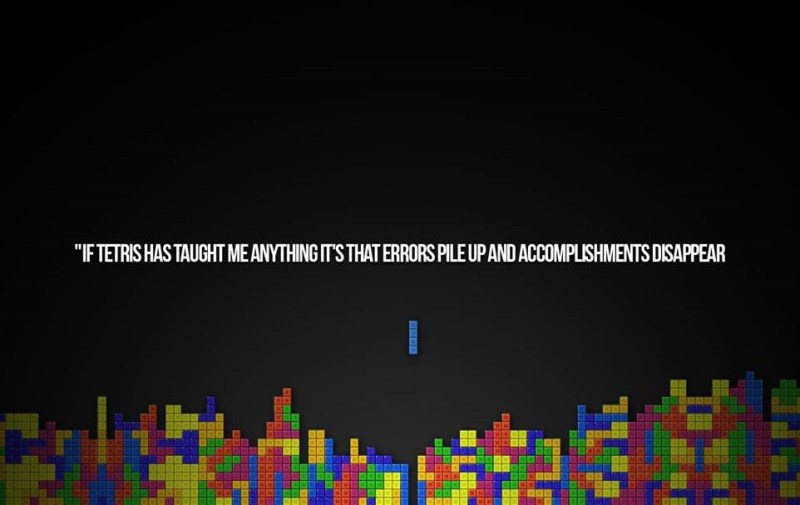
    6. Errors pile up, accomplishments disappear: Remember how much effort you put in closing that important contract six months ago? Maybe you do, but nobody else does, people have moved on. On the other hand, that time where you delivered a bad presentation, or when you lost your temper on a meeting? Yep, that’s not going away from people’s memories.

Remember that Tetris is just a game, it should be enjoyed 😉

tetris

Aristotle vs Shopenhauer. Please, don’t try to be right

Around 350 years B.C. lived Aristotle, who founded the Peripatetic school. Aristotle and his disciples’ aim was to find truth by discussing, and bouncing ideas of each other while taking nice walks under the Athenian sun. Aristotle would ask questions to find truth by induction, arriving at conclusions from known facts to reach higher levels of understanding.

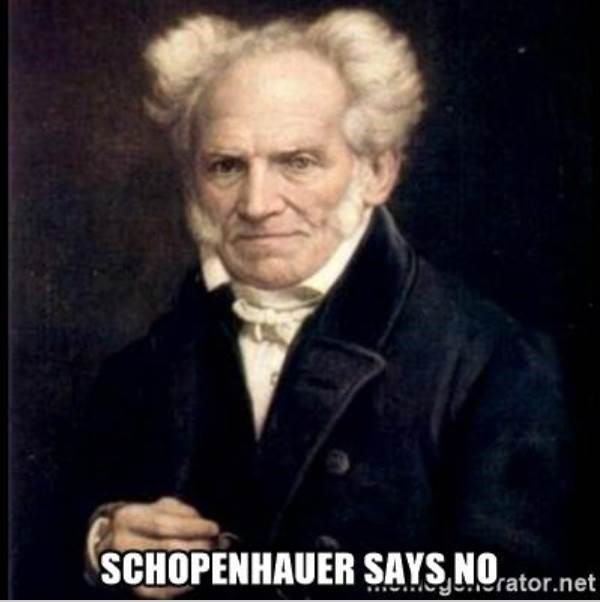
Fast forward to 1831. German philosopher Arthur Schopenhauer, example of philosophical pessimism, wrote “The art of being right: 38 ways to win an argument” , his goal was not to find the truth, but to win dialectic fights. He saw discussion as a competition to which the goal was to win, instead of a way to enrich each other and humanity through arriving at better understanding of the universe.

In my life I have met many people with which it is very nice to discuss, because their clear goal is to use logic to progress together, to shine a light on the unknown, and to help each other.

I have also met quite a few people who believe the most important thing is to be right, who will use every trick in the book to win the conversation and come out on top. It is not difficult to know when you’ve met one.

Here are a few of Schopenhauer’s logical fallacies, so you can be ready to point them out and avoid these traps:

  1. The Homonymy: extend the understanding of a particular word, and the refute it triumphantly. Claiming credit for having refuted the original stament.

“You are not yet initiated into the mysteries of the Kantian philosophy.”
…”Oh, if it’s mysteries you’re talking of, I’ll have nothing to do with them.”

  1. Generalize your opponent’s specific statements: Take a proposition which has been said concretely, as though it had been said with absolute application.

“A Moor is black; but in regard to his teeth he is white; therefore, he is black and not black at the same moment.”

  1. Bandwagon Fallacy: Arguments that appeal to the growing popularity of an idea as a reason for accepting it is true.

“Increasingly, people are coming to believe that Eastern religions help us to get in touch with our true inner being. Therefore: Eastern religions help us to get in touch with our true inner being.”

  1. Fallacy of Division: If the whole has a property, then every part has this property.

“Water is liquid, therefore H20 molecules are liquid”, “Atoms are invisible, I am made of Atoms, therefore I am invisible”

  1. Straw Man Fallacy: Misrepresent a position to make it appear weaker than it actually is. Refute the misrepresentation and claim the real position has been refuted.

After Will said that we should put more money into health and education, Warren responded by saying that he was surprised that Will hates our country so much that he wants to leave it defenceless by cutting military spending.

  1. False Cause: Explain correlation as causation

Pointing to a fancy chart, Roger shows how temperatures have been rising over the past few centuries, whilst at the same time the numbers of pirates have been decreasing; thus pirates cool the world and global warming is a hoax.

  1. Slippery Slope: If we allow A to happen, then Z could happen. Therefore A should not happen.

Colin Closet asserts that if we allow same-sex couples to marry, then the next thing we know we’ll be allowing people to marry their parents, their cars and even monkeys.

  1. Ad Hominem: attack your opponent’s personal traits in an attempt to undermine their argument.

After Sally presents an eloquent and compelling case for a more equitable taxation system, Sam asks the audience whether we should believe anything from a woman who isn’t married, was once arrested, and smells a bit weird.

We need to work together in search of the solutions to our daily struggles, hence a positive Aristotelian attitude is helpful and very appreciated, whereas trying to “win” conversations is damaging and discouraging.

shopenhauer


Emergent behaviors and IT Projects

Did you know that the largest known ant colony goes from northern Italy to the Spanish Atlantic coast? Yet ants don’t have an architect overseeing their construction, or a centralized coordination group which tells the rest of the ants what they have to do.

Ants are simple individuals with very limited communication skills, yet they are capable of forming minimum paths from the colony to the food and form efficient ant chains moving the food to the colony.

Grasscutter ants harvest tons of grass every year which they can’t digest, bring it to their colony, cut it to the right size and place it into a garden of fungus, which eats the grass and the ants eat the fungus. It’s not one or two intelligent outliers that do this. It’s the colony that does this to feed it’s 5.000 individuals.

Termites create 6 meter high “cathedrals”, with no central coordination, just simple rules that are wired into each individual’s DNA guiding them to release certain chemicals in response to stimuli such as proximity to other chemicals.

Birds fly in organized flocks without having radio communication to coordinate their positions and speeds, following 3 simple rules: 1) avoid getting too close to neighbor, 2) steer towards average heading of neighbors 3) steer towards average position of neighbors.

Wolves hunt in packs circling the prey with no communication needed, just following two rules: 1) get close to the prey 2) when close enough to the prey, move away from other wolves.

Fish swim in groups, homogeneous groups are called schools and heterogeneous are called schoals. This reduces their chance of being eaten by a predator. This chance is further reduced by joining a schoal of bigger fish, which will be preferred by predators. One puzzling aspect of schoal selection is how a fish can choose to join a schoal of fish similar to themselves, given that they cannot know their own appeareance.

The set of rules that the individuals follow is easy to understand, but the emerging behavior of the group is in no transparent way derived from this set of rules.

Would there be a set of rules that would enable us to work efficiently in projects without the need for central coordination?

ants

Ease with uncertainty using the cosmic scale

“The most merciful thing in the world, I think, is the inability of the human mind to correlate all its contents. We live on a placid island of ignorance in the midst of black seas of infinity, and it was not meant that we should voyage far. The sciences, each straining in its own direction, have hitherto harmed us little; but some day the piecing together of dissociated knowledge will open up such terrifying vistas of reality, and of our frightful position therein, that we shall either go mad from the revelation or flee from the deadly light into the peace and safety of a new dark age.”

The Call of Cthulhu – H.P. Lovecraft

As you read this, sitting on your chair, sipping on your coffee, you are hurling through a dark, cold and incomprehensibly vast space on a gigantic ball of dirt which is rotating around our sun at 30 km/second. Us and our neighboring galaxies are rushing at 1,000km/second towards a structure we call the great attractor, with a mass of 100 quadrillion times that of our Sun and 150 million light-years away.

You are not an individual. The visible universe is composed of 1080 atoms. You are composed of 1027 of these same atoms, 99% of which form hydrogen, oxygen and carbon. These atoms that compose you, group in molecules, which group in cells, which create you. These cells are living and performing tasks like digesting your food, transporting endorphins to make you happy, or killing other beings which are inside your body so you don’t get sick.

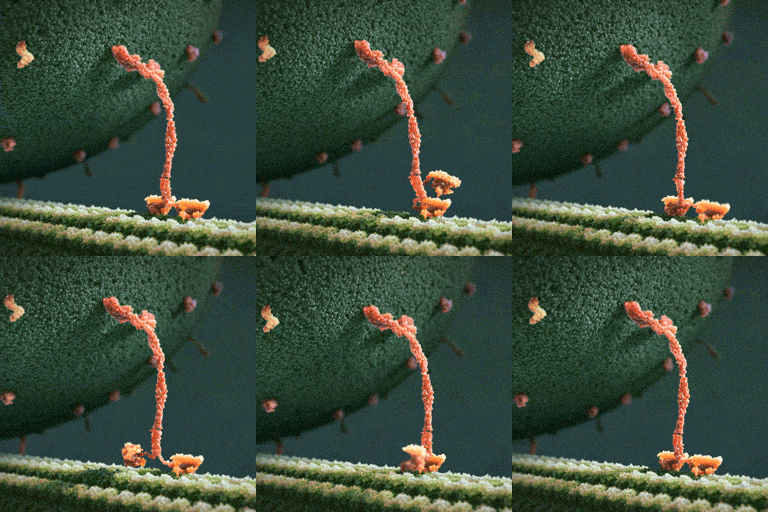
Check out below, a kinesin protein which is walking around inside one of your cells right now, transporting some vesicles to keep the cell working.

kinesin

The universe has existed for over 14 billion years, and will exist for many billion years to come. If we compare the age of the universe to one calendar year, on the first of January we would have had the big bang, around September the solar system would have formed. Dinosaurs would have become extinct on 29th of December, and Jesus Christ would have been born on the 31st of December 5 seconds before midnight. Columbus would have reached the Americas 1.2 seconds before midnight. Your whole life, with all your trials and tribulations will have gone by in less than 0.23 cosmic seconds.

Think about this when you are worried about your performance review or your project getting delayed.